The Work Agents Can Absorb
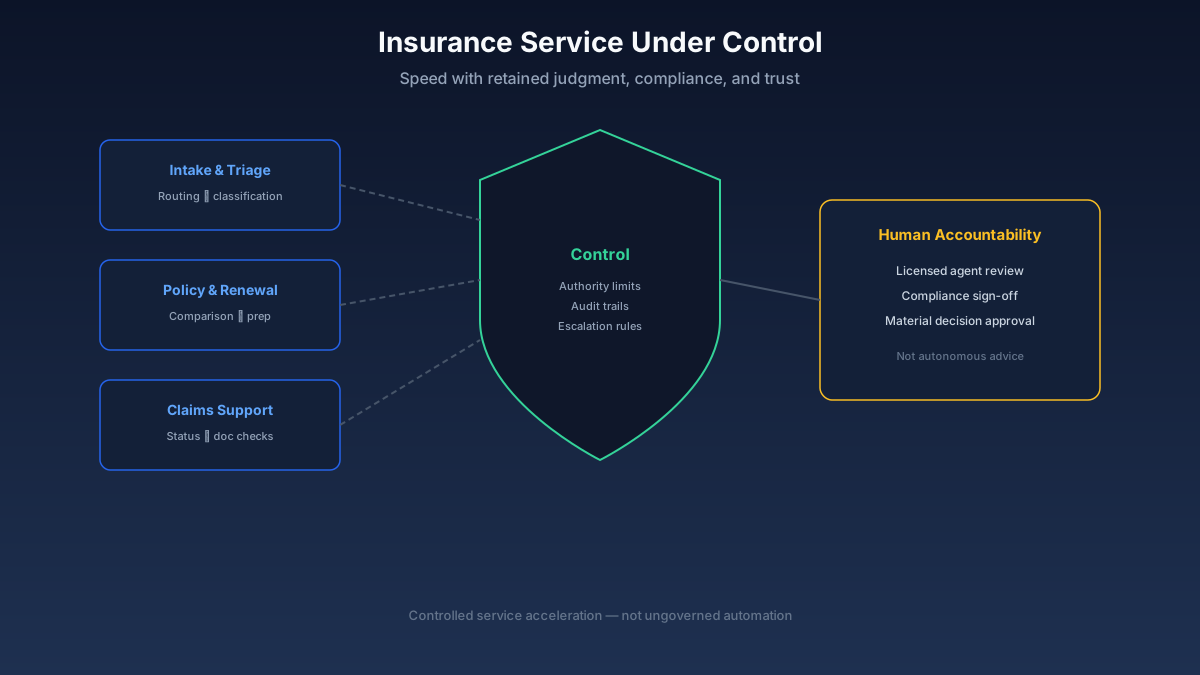
Much of agency and service operations is repetitive but not mindless. Classifying an inbound request. Gathering identifiers and documents. Assembling a renewal comparison. Checking that required disclosures appear before a letter goes out. Flagging a claims file missing an adjuster-ready document.
These tasks consume licensed time that should go to judgment — coverage tradeoffs, difficult conversations, exceptions that do not fit a script. Agents belong there, as prep and routing, not as substitutes for a professional who holds the license.
Where the Line Is
Agents can classify, gather, compare, draft, and flag. They should not bind coverage, send final client advice without review, adjudicate claims, or file regulatory submissions on their own.
That line is not conservative for its own sake. It reflects how supervision actually works. A plausible paragraph about exclusions is still a suitability event if it reaches the client unchecked.
| Work | Agent | Licensed professional | |---|---|---| | Intake / triage | Classify, collect, route | Own complex or ambiguous cases | | Renewal | Assemble options, highlight gaps | Approve recommendation, lead conversation | | Claims support | Status, document completeness | Decisions on settlement | | Compliance prep | Checklists, missing disclosure flags | Sign-off before send |
If your use case does not fit a row cleanly, that is a signal to slow down, not to widen autonomy.
Controls That Actually Matter
Sources. Policy, rating, and client data from authoritative systems — current endorsements, not a PDF from someone’s desktop.
Limits. Written boundaries on what the agent may draft, send, or update. "Human in the loop" is too vague for an exam.
Escalation. Ambiguity routes to a named licensee with context attached — not to a generic queue.
Record. What was retrieved, generated, escalated, and approved, retained to state and carrier expectations.
Outcomes. Track service results — resolution, errors caught, client satisfaction — not agent activity volume. Busy automation that does not move quality is still waste.
Examiners and E&O Underwriters Ask the Same Things
Can you show licensed review of material advice before it reached the client? Can you reconstruct agent actions? Are data sources current and owned? Do escalation paths work in practice, not only on paper? Is there a named owner for each deployment?
If any answer requires a week of forensic IT work, you are not examination-ready — regardless of how polished the demo was.
E&O carriers are beginning to treat autonomous client communication as a risk multiplier. Human review of outbound advice, documented limits, tested escalation, and honest audit trails are how you keep coverage and trust aligned.
Rollout Without Theater
Choose one domain — renewal prep is often the right first bet. Write the authority matrix. Pilot with a small team. Review outputs weekly with licensees and compliance, adjust bounds, measure handle time and error catch rate. Expand only when the record is defensible.
Skipping review because "the model is usually right" is how agencies learn the expensive meaning of usually.
Key Takeaways
- Insurance AI succeeds as controlled acceleration — prep and route — not as autonomous advice.
- Regulatory and E&O readiness are the real gates, not model benchmarks.
- Outcome metrics and audit trails matter more than deployment counts.
Strategic Recommendations
- Prohibit autonomous binding and unsupervised client-facing recommendations in policy, not in slide footnotes.
- Require licensee sign-off on outbound material before send.
- Treat authority matrices and escalation maps as governance documents shared with compliance and carriers.
Next Steps
- Map planned use cases to the prepare/decide line; stop anything that blurs it.
- Verify source authority for every system an agent reads.
- Schedule a carrier or compliance review before scaling beyond a pilot team.