What Changed in the Enterprise Conversation
Before general-purpose chat interfaces, generative AI lived primarily in specialized domains — code completion, marketing copy assistance, narrow vertical models. The shift was not only capability but who could invoke it. Line managers could produce customer-facing text without routing through legal. Engineers could paste proprietary snippets into public tools unless IT had already drawn boundaries.
That democratization is the governance challenge. The model is not the risk surface alone. The workflow around it is: what data enters the prompt, what leaves the building, what gets sent to a client without review, what cost accrues token by token at scale.
Discipline Means Specific Choices
Model selection tied to the decision. A summarization task does not need the largest context window on the market. A coding assistant does not belong in a contract interpretation workflow without evaluation. Match capability, latency, and cost to the decision class — document the rationale.
Data boundaries and intellectual property. Generative models should not receive regulated, confidential, or client data without an explicit classification review and contractual coverage. "Employees know not to" is not a control. Blocking, redaction, enterprise endpoints, and retention policies are.
Evaluation before scale. Define success and failure before the pilot expands: factual accuracy on a labeled set, hallucination rate on policy Q&A, human review time saved, customer escalation rate. Without baselines, you cannot distinguish improvement from anecdote.
Human accountability for material outputs. Someone must sign off on client-facing, financial, or compliance-sensitive content — or the system must stay in draft-only mode. Accountability is a role, not a checkbox on a vendor form.
Cost, latency, and quality as operating metrics. Token spend spikes quietly. Latency breaks user adoption. Quality drifts as models or prompts change. Finance and operations should see these metrics alongside functional KPIs.
Where Value Is Legitimate
Internal productivity — drafting, summarizing, restructuring information under human review — is the lowest-risk starting point most organizations already prove.
Decision preparation — assembling briefings, comparing scenarios, extracting clauses for expert review — creates executive leverage when sources are controlled and outputs are labeled as assistive, not authoritative.
Customer and employee service — when grounded in approved knowledge and bounded by escalation — can reduce handle time. Ungrounded service bots create reputational and regulatory debt.
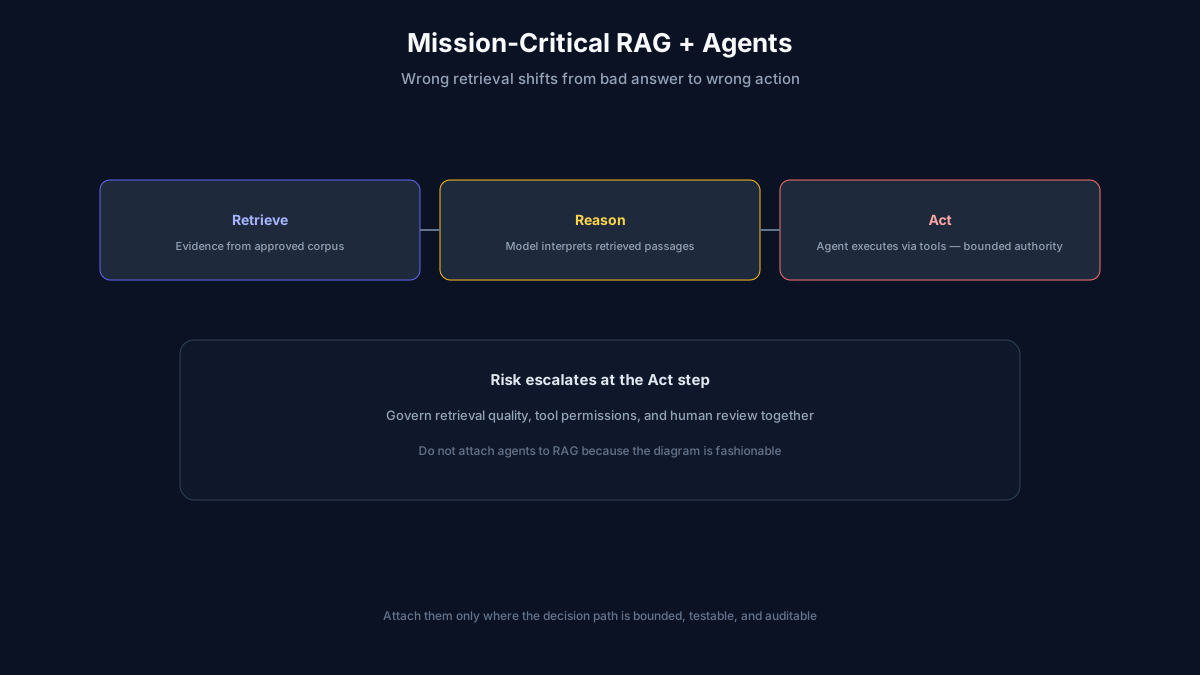
What is rarely legitimate on day one: fully autonomous decisions on high-consequence outcomes without evaluation infrastructure you would accept for any other system.
Using NIST AI RMF Without the Paperwork Spiral
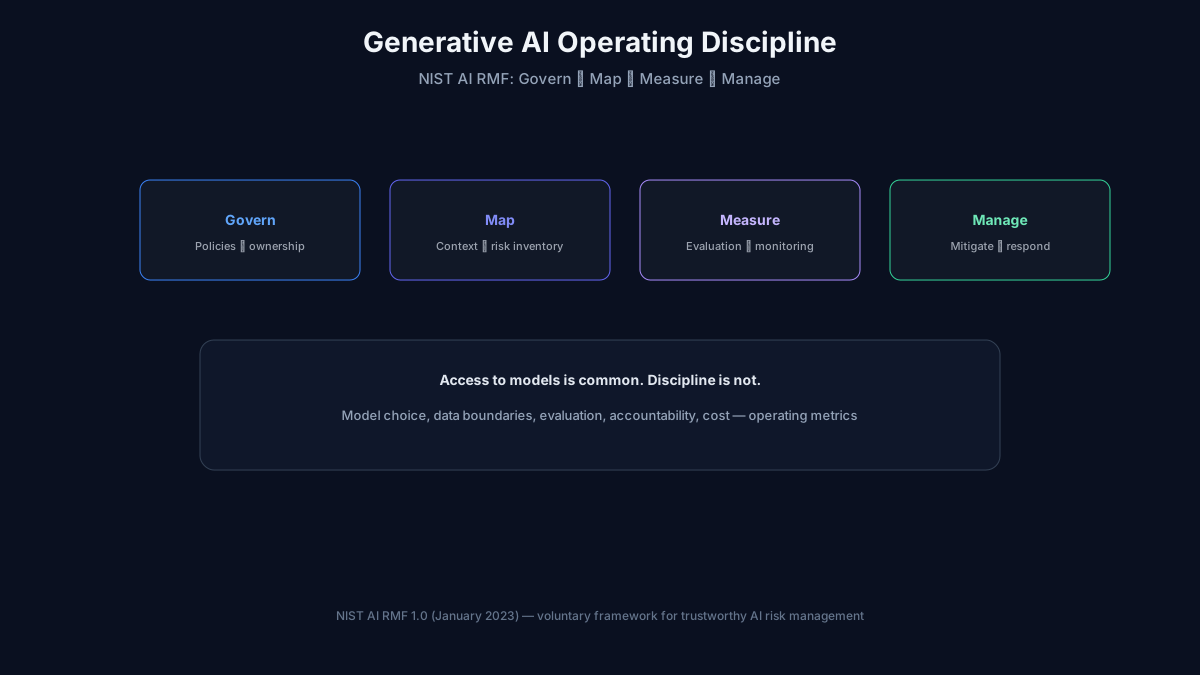
The framework is voluntary and sector-agnostic — that is a feature. Govern: who owns AI risk and policy. Map: which systems use generative AI, on what data, for what decisions. Measure: how you evaluate performance and harm. Manage: how you respond when metrics slip.
You do not need a perfect framework implementation to start. You need the four questions answered in writing for each material use case.
Key Takeaways
- Access to generative models is commoditized; discipline — data, evaluation, ownership, cost — is the differentiator.
- NIST AI RMF 1.0 provides a practical Govern-Map-Measure-Manage structure for organizations building policy from scratch.
- Material outputs require human accountability or strict draft-only boundaries; fluency is not correctness.
Strategic Recommendations
- Maintain a use-case register with data classification, model choice, owner, and evaluation criteria for every production generative AI workflow.
- Prohibit unreviewed client-facing content from public tools; provide enterprise endpoints where use is approved.
- Report cost and quality metrics monthly for any generative workload above trivial spend.
Next Steps
- Audit shadow use of public chat tools against data classification policy.
- Select one high-value use case and publish its evaluation baseline before expansion.
- Assign a single executive owner for generative AI risk reporting to the leadership team.